

Sem Resultado
Ver Todos Os Resultados
Newsletters
Agroportal
  • Login
  • Registar
  • Sugeridas
  • Notícias
    • Notícias
    • Nacional
    • Internacional
    • Comunicados

    teste

    PS acusa Bolieiro de tentar "omitir extraordinário percurso" socialista

    Ações de Sensibilização em Agricultura e Produção Biológica AGROBIO – Associação Portuguesa de Agricultura Biológica

    Ações de Sensibilização em Agricultura e Produção Biológica AGROBIO – Associação Portuguesa de Agricultura Biológica

    Iberdrola utiliza parque fotovoltaico como local de pasto para ovelhas

    Iberdrola utiliza parque fotovoltaico como local de pasto para ovelhas

    A economia circular ao serviço da qualidade dos solos

    Governo está a estudar formas de garantir que os alimentos cheguem a preços justos ao consumidor

    Preços dos alimentos. Governo diz procurar soluções justas

  • Opinião

    É urgente a recuperação dos ecossistemas para travar o declínio dos polinizadores

    Foi entre 2011 e 2016, em anos da Troika, que as explorações agrícolas portuguesas tiveram o melhor desempenho económico das ultimas três décadas

    António Covas

    Transição digital, inteligência territorial e incumbentes principais

    De olhos postos na agricultura do futuro

    João Dinis

    Secretaria de Estado da Agricultura afinal está em coma induzido…

    Manuel Cardoso

    Agricultura e manifs

    O poder de compra médio dos Agricultores Portugueses caiu em 2022 cerca de 25%

    Manuel Chaveiro Soares

    Importa ultrapassar o envelhecimento demográfico em Portugal

    João Vacas

    O semestre AGRI em antevisão

  • Eventos
  • Dossiers

    Dossiers I

    • Agricultura Biológica
    • Apoios
    • Artigos Técnicos
    • Biossoluções
    • Cadeia Alimentar
    • Fertilizantes
    • Financiamento
    • Fitofarmacêuticos

    Dossiers II

    • Florestas
    • Futuro da PAC
    • Inovação
    • Mercados
    • Newsletters e Revistas
    • Práticas Culturais
    • Seguros

    Últimas

    Governo está a estudar formas de garantir que os alimentos cheguem a preços justos ao consumidor

    15/03/2023

    Preços dos alimentos. Governo diz procurar soluções justas

    15/03/2023

    A conspiração da mercearia – Henrique Monteiro

    15/03/2023

    DECO defende criação de observatório de preços

    15/03/2023

    Governo cria observatório dos preços que existe desde 2015

    15/03/2023

    Preços dos alimentos. Governo diz procurar soluções justas

    15/03/2023
  • Serviços
    • Diretório
    • Emprego
    • Máquinas Agrícolas
    • Meteorologia
    • Terrenos Agrícolas
    • Arquivo Agroportal
Agroportal
  • Sugeridas
  • Notícias
    • Notícias
    • Nacional
    • Internacional
    • Comunicados

    teste

    PS acusa Bolieiro de tentar "omitir extraordinário percurso" socialista

    Ações de Sensibilização em Agricultura e Produção Biológica AGROBIO – Associação Portuguesa de Agricultura Biológica

    Ações de Sensibilização em Agricultura e Produção Biológica AGROBIO – Associação Portuguesa de Agricultura Biológica

    Iberdrola utiliza parque fotovoltaico como local de pasto para ovelhas

    Iberdrola utiliza parque fotovoltaico como local de pasto para ovelhas

    A economia circular ao serviço da qualidade dos solos

    Governo está a estudar formas de garantir que os alimentos cheguem a preços justos ao consumidor

    Preços dos alimentos. Governo diz procurar soluções justas

  • Opinião

    É urgente a recuperação dos ecossistemas para travar o declínio dos polinizadores

    Foi entre 2011 e 2016, em anos da Troika, que as explorações agrícolas portuguesas tiveram o melhor desempenho económico das ultimas três décadas

    António Covas

    Transição digital, inteligência territorial e incumbentes principais

    De olhos postos na agricultura do futuro

    João Dinis

    Secretaria de Estado da Agricultura afinal está em coma induzido…

    Manuel Cardoso

    Agricultura e manifs

    O poder de compra médio dos Agricultores Portugueses caiu em 2022 cerca de 25%

    Manuel Chaveiro Soares

    Importa ultrapassar o envelhecimento demográfico em Portugal

    João Vacas

    O semestre AGRI em antevisão

  • Eventos
  • Dossiers

    Dossiers I

    • Agricultura Biológica
    • Apoios
    • Artigos Técnicos
    • Biossoluções
    • Cadeia Alimentar
    • Fertilizantes
    • Financiamento
    • Fitofarmacêuticos

    Dossiers II

    • Florestas
    • Futuro da PAC
    • Inovação
    • Mercados
    • Newsletters e Revistas
    • Práticas Culturais
    • Seguros

    Últimas

    Governo está a estudar formas de garantir que os alimentos cheguem a preços justos ao consumidor

    15/03/2023

    Preços dos alimentos. Governo diz procurar soluções justas

    15/03/2023

    A conspiração da mercearia – Henrique Monteiro

    15/03/2023

    DECO defende criação de observatório de preços

    15/03/2023

    Governo cria observatório dos preços que existe desde 2015

    15/03/2023

    Preços dos alimentos. Governo diz procurar soluções justas

    15/03/2023
  • Serviços
    • Diretório
    • Emprego
    • Máquinas Agrícolas
    • Meteorologia
    • Terrenos Agrícolas
    • Arquivo Agroportal
Sem Resultado
Ver Todos Os Resultados
Agroportal

Grassland studies, radar-tracked bumblebees offer clues for protecting pollinators

por Horizon - EU
26-04-2020 | 22:00
em Últimas, Internacional
Tempo De Leitura: 7 mins
A A
0
VISITAS
Partilhe no FacebookPartilhe no TwitterEnviar para o WhatsappEnviar para o TelegramEnviar para o LinkedIn

Wild bees are major pollinators of crops in Europe such as peas, beans and oilseed rape. But as their numbers decline, there is a need to monitor and boost bee populations and understand the consequences of fewer bees.

And pollinators are not just important for crops – but also wild plants. Falling bee numbers are likely already having an impact – we just don’t know exactly what that is.  

‘We have seen declines in pollinators as land use has intensified,’ said Professor Yann Clough, ecologist at Lund University in Sweden. ‘It is not just crops, but wild plants which they pollinate, which begs the question, do declines in pollinators mean we will see declines in the reproduction of wild plants?’

Some plants such as grasses can thrive without pollinating insects because they are wind pollinated.  Others rely exclusively on insects to reproduce. Many wildflowers especially are pollinated by wild bees such as bumblebees. This includes vetches, peas such as yellow bird’s-foot trefoil and many types of daisy.

‘About one-third of plants do not at all depend on insects for pollination, and a third do, to some extent,’ Prof. Clough said. ‘Another third then are highly dependent on insects for pollination.’

Without bees, ecosystems could tilt towards plants that do not need bees, nor cater for them. Fewer bees would mean less diversity in wild plants and pollinators and could impact birds and mammals that depend on them.

Prof Clough is studying two dozen flower-rich grasslands in Sweden to better understand how the landscapes surrounding these sites influence bee numbers and the plants growing there through a project called DrivenByPollinators.

Grasslands 

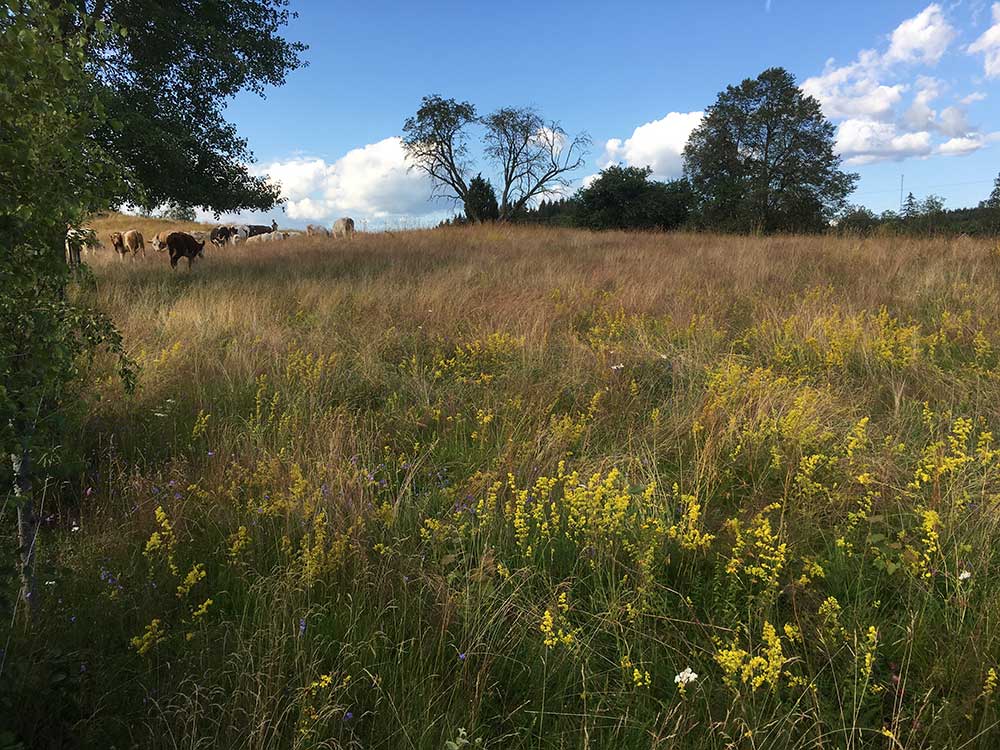
The semi-natural grasslands Prof. Clough studies in Sweden are ‘unimproved’, meaning they were probably never ploughed or fertilised. ‘They tend to have boulders in them,’ he said. Cattle, sheep and goats graze there.

Over the past 150 years, semi-natural grasslands in Sweden have reduced by about 90%, he says. They are now mostly small fragments, oases of biodiversity in a sea of intensively managed fields of crops such as potato or wheat.

‘These semi-natural grasslands are like our rainforests, in terms of the density of species and the rarity of some species here,’ said Prof. Clough. This is because a diverse community of flowers, insects, birds and other animals live and depend on one another in these habitats. 

It is likely that what happens in these grasslands will depend strongly on the surrounding countryside, since insect pollinators are mobile and many bees rely on pollen and nectar in the wider landscape.

‘We are concerned that the quality of these fragments might decrease due to the indirect effects of intensive management in the surrounding landscape,’ said Prof. Clough.

To study the impact of the countryside, he and his team will measure over several years the seeds produced and number of seedlings in the grasslands. In one experiment, Prof. Clough is shutting out pollinators from small sections of the wild fields with a tent-like netting-covered dome structure to study the impact on plant communities.

‘These semi-natural grasslands are like our rainforests, in terms of the density of species and the rarity of some species here.’

Prof. Yann Clough, Lund University, Sweden

A fall in wild bees and other pollinators could help change grassland composition, for example. ‘That might lead to a shift towards more grasses, and less legumes, which fix nitrogen in these grasslands,’ said Prof. Clough. Legumes plants such as peas and clover take unreactive nitrogen from the air, and with the assistance of microbial partners on their roots, turn it into nitrogen-rich fertiliser compounds for other plants.

This could have knock-on effects for the ecosystem and for farmers. More grasses and fewer flowers mean drier and less nutritious fodder for grazing animals.

Farmers can receive subsidies for grazing grasslands to conserve biodiversity. If, within a few years, agriculture policy in Europe moves towards a more results-based payment for biodiversity friendly management, farmers will want to be sure that the biodiversity in their grasslands is not slowly eroding because of the surrounding landscape, says Dr Clough.  

Flower strips

Prof. Clough hopes to use his results to draw up recommendations on how to best manage the landscapes around grasslands for pollinators such as bumblebees. ‘It might mean conserving more natural habitat around some grasslands, or putting in (pollinator friendly) flower strips in the wider landscape, or creating (bee) nesting sites by planting hedge or wood habitats,’ he said.   
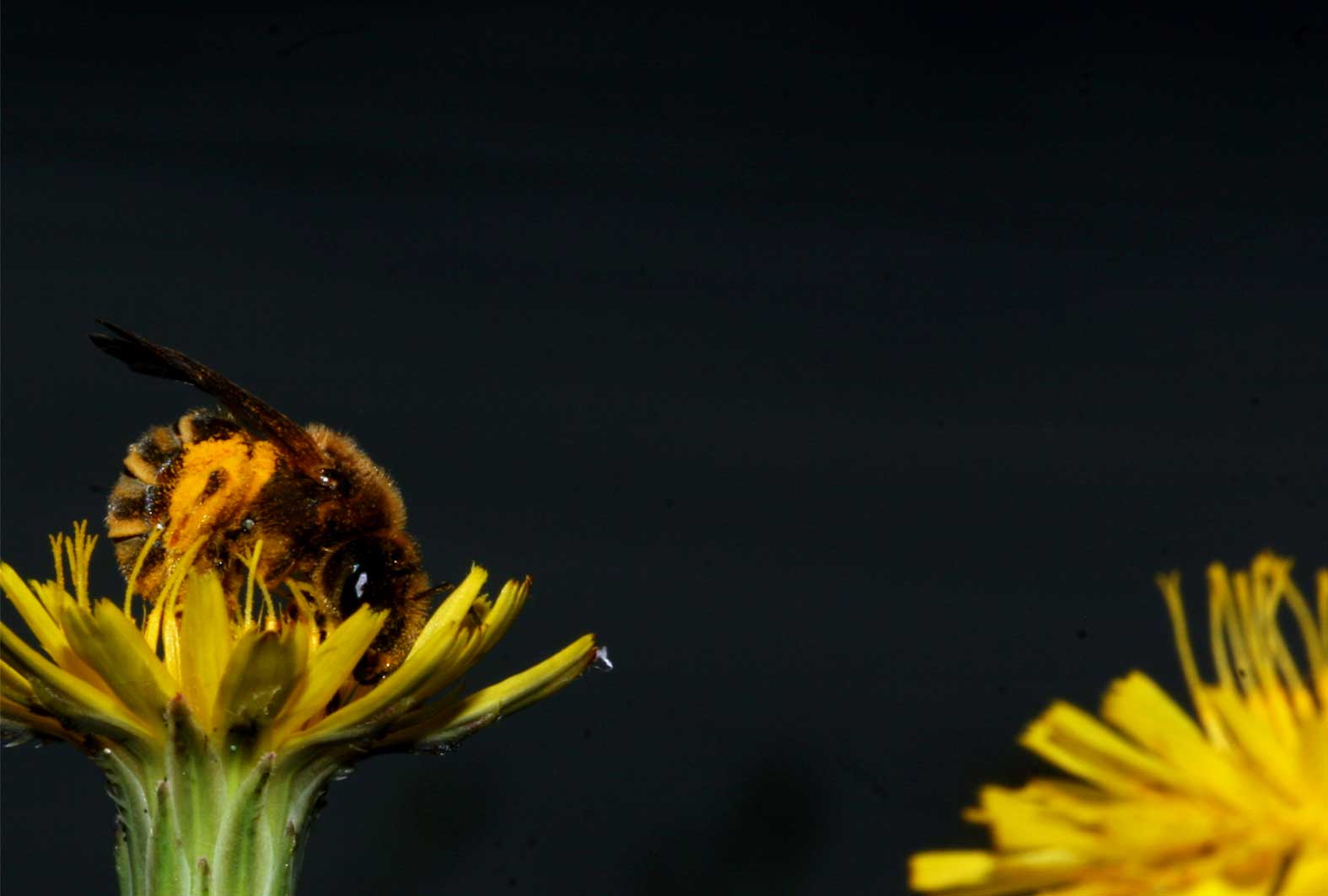
For the first time ever, researchers tracked a bumblebee from its maiden flight to death. Image credit - Yann Clough

But studying exactly how declining pollinator populations affect biodiversity is a challenge, as is studying any changes to bee behaviour and foraging.

One way to study an animal’s behaviour is to track it. For large mammals such as bears or deer, a collar can be placed around their neck to follow their movements. But with bumblebees, this is tricky.

At an agriculture research station north of London, however, scientists were able to glue a lightweight harmonic radar to the backs of bees. It acts as a signal deflector which allows the bee to be traced as they forage. A radar dish emits a signal, which bounces off the transponder, and this signal is picked up by a receiving radar. The position of the bee is pinpointed every few seconds.

‘With two different radars mounted on the same (truck) trailer, that allows us track the bees up to a kilometre away,’ said Professor Lars Chittka, behavioural ecologist at Queen Mary University of London, UK, and leader of the SpaceRadarPollinator project, which tracked the bees.

The team aims now to build multiple such radars and place them over a larger area to track bees for longer distances. 

Altitude

Until now, they have only tracked the position but not the altitude of the bee. ‘The biggest breakthrough is the 3-dimensional tracking,’ said Prof. Chittka, which he hopes to test in the summer. ‘That will allow us reconstruct what the bee sees while in flight. We can see how it memorises landmarks and uses them (for orientation).’

A 3-D video simulation of a bee out to forage

Video credit – Vince Gallo

Bee tracking could allow scientists to offer advice on how best to conserve pollinators. ‘It is important for us to understand bees’ foraging needs,’ said Prof. Chittka. ‘Not just what resources they require, but also how they should be distributed in space.’

It might be better to have strips of connected habitat planted along field margins or the edges of roads, for example.

‘We hope to get exact predictions of how far apart habitats are allowed to be, or at what point foraging behaviour or dispersal of queens might be disrupted,’ he said.

The project for the first time ever tracked a bumblebee from maiden flight until death. Bees initially explored their surroundings, departing on orientation flights in different directions and looping back to their nest. Typically, they then located a profitable flower patch and spent lots of time revisiting it. 

But not all bees follow the same strategy. ‘Some individuals were relatively faithful to flower patches, while others were wanderers all their lifetime,’ said Prof. Chittka.

Four bumblebees were tracked as part of the project. Most lived three to four weeks, before disappearing off the radar, presumed eaten by birds. ‘We give them a number, like 007, to identify them,’ Prof. Chittka said. 

Prof. Clough says that little is still known about how pollinators use the landscape, which makes it difficult to know what pollinator-friendly steps we can take.

He says that technical developments that shed more light into their movements are very much welcome. ‘The generated knowledge could be used to inform models for pollinator foraging, such as those that we are using in our research,’ he said.

The research in this article was funded by the EU’s European Research Council. If you liked this article, please consider sharing it on social media.


Imprimir Artigo
Publicação Anterior

“A Grande Entrevista” – Maria do Céu Albuquerque

Próxima Publicação

Continente integra 40 novos produtores e compra mais de 71 milhões de euros à produção nacional

Artigos Relacionados

Nacional

PS acusa Bolieiro de tentar "omitir extraordinário percurso" socialista

14/04/2025
Últimas

Inquérito: Atividades farmacêuticas na distribuição

06/07/2023
Nacional

Ações de Sensibilização em Agricultura e Produção Biológica AGROBIO – Associação Portuguesa de Agricultura Biológica

23/06/2023
Próxima Publicação
Clube de Produtores Continente

Continente integra 40 novos produtores e compra mais de 71 milhões de euros à produção nacional

Discussão sobre este post

Dossiers

  • Agricultura Biológica
  • Apoios
  • Artigos Técnicos
  • Biossoluções
  • Cadeia Alimentar
  • Fertilizantes
  • Financiamento
  • Fitofarmacêuticos
  • Florestas
  • Futuro da PAC
  • Inovação
  • Mercados e Cotações agrícolas
  • Newsletters e Revistas
  • Práticas Culturais
  • Seguros

Serviços

  • Diretório
  • Emprego
  • Máquinas Agrícolas
  • Meteorologia
  • Terrenos Agrícolas
  • Arquivo Agroportal

Empresas em Destaque

  • Syngenta Crop Protection Lda.
  • Anipla – Associação Nacional da Indústria para a Proteção das Plantas
  • BASF Portuguesa S.A.
  • Lusosem – Produtos para a agricultura S.A.
  • Portugal Fresh – Associação para a Promoção das Frutas, Legumes e Flores de Portugal
  • NOP – New Organic Planet, LDA
  • Atlas MGA
  • Abreu Advogados
  • CA Seguros – Companhia de Seguros de Ramos Reais, SA
  • ANSEME – Associação Nacional dos Produtores e Comerciantes de Sementes

Últimas entradas

  • Ceres Imaging
  • INTERAGRO
  • Ambitrevo, Soluções Agrícolas e Ambientais, Lda.
  • Ceres Imaging
  • Detail Landscaping
  • GoFigo Agrupamento de Produtores

Temas em destaque

Apicultura Arroz Azeite Batata Doce Cereais Cistusrumen Floresta Hortofruticultura Milho Produção Animal Rega Trigo Vinho

Dossiers

  • Agricultura Biológica
  • Apoios
  • Artigos Técnicos
  • Biossoluções
  • Cadeia Alimentar
  • Fertilizantes
  • Financiamento
  • Fitofarmacêuticos
  • Florestas
  • Futuro da PAC
  • Inovação
  • Mercados e Cotações agrícolas
  • Newsletters e Revistas
  • Práticas Culturais
  • Seguros

Eventos

Abril 2026
STQQSSD
   1 2 3 4 5
6 7 8 9 10 11 12
13 14 15 16 17 18 19
20 21 22 23 24 25 26
27 28 29 30    
« Mar   Mai »

Próximos eventos

Dossiers

  • Agricultura Biológica
  • Apoios
  • Artigos Técnicos
  • Biossoluções
  • Cadeia Alimentar
  • Fertilizantes
  • Financiamento
  • Fitofarmacêuticos
  • Florestas
  • Futuro da PAC
  • Inovação
  • Mercados e Cotações agrícolas
  • Newsletters e Revistas
  • Práticas Culturais
  • Seguros

Newsletter emprego

Subscrever Newsletter Emprego

Verifique na sua caixa de correio ou na pasta de spam para confirmar a sua subscrição.

Formulário

Serviços

  • Diretório
  • Emprego
  • Máquinas Agrícolas
  • Meteorologia
  • Terrenos Agrícolas
  • Arquivo Agroportal

Formulário

Sobre Nós

O Agroportal.pt é uma plataforma de informação digital que reúne a informação relevante sobre agricultura. Tem um foco na Política Agrícola Comum e a sua aplicação em Portugal.

Menu

  • Quem somos
  • Envie-nos informação
  • Anuncie connosco
  • Newsletters
  • Estatuto Editorial
  • Ficha técnica
  • Proteção de Dados Pessoais
  • Disclaimer
Facebook twitter Circle Instagram Rss Feed

© Agroportal. All Rights reserved.

  • Login
  • Registar
Sem Resultado
Ver Todos Os Resultados
  • Sugeridas
  • Notícias
  • Opinião
  • Eventos
  • Dossiers
  • Serviços
    • Diretório
    • Emprego
    • Máquinas Agrícolas
    • Meteorologia
    • Terrenos Agrícolas
    • Arquivo Agroportal

© Agroportal. All Rights reserved.

Bem-Vindo De Volta!

Sign In with Facebook
Sign In with Google
OU

Faça login na sua conta abaixo

Esqueceu-se da senha? Registar

Criar Uma Nova Conta!

Sign Up with Facebook
Sign Up with Google
OU

Preencha os campos abaixo para se registar

* Ao se registar-se no nosso site, você concorda com os Termos e Condições e a Política de Privacidade .
Todos os campos são necessários. Entrar

Obter a sua senha

Indique por favor o seu nome de utilizador ou endereço de E-mail para repor a sua senha.

Entrar
Este site usa cookies. Ao continuar a utilizar este site, está a dar consentimento à utilização de cookies. Visite a nossa Política de Protecção de dados e Cookies.